Engineering Without Boundaries: Building a Unified Engineering Platform from Physics to Flight
By Evan
If you've worked on any advanced hardware program — aerospace, defense, automotive — you already know the problem. Your aero, GNC, and structures teams are all engineering the same vehicle, but they're doing it in completely separate environments with separate toolchains, separate data formats, and separate assumptions. They're solving deeply coupled problems in total isolation.
That isolation has a cost. Every integration point becomes a manual translation exercise — re-deriving aerodynamic models for GNC, re-validating structural limits against updated loads, reconciling assumptions that drifted apart weeks ago. It's not just slow. It compounds risk, because engineering context degrades at every boundary.
We started Navier AI to fix this. We're building a connected engineering environment where disciplines share context natively, accelerated by AI agents that handle the tedious work so engineers can focus on the actual engineering. Here's what that looks like in practice.
The Next-Gen Hardware Simulation Stack
1. Mission Intent → Simulation Environment
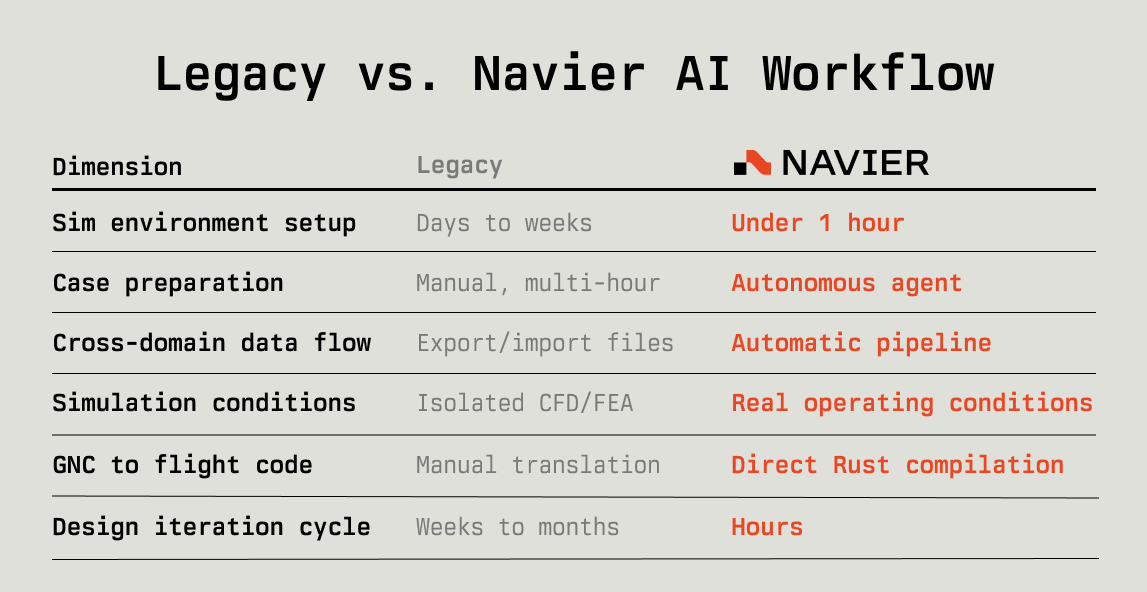
Most aerospace programs spend days, sometimes weeks, just standing up mission simulations. Defining orbital parameters, configuring environmental assumptions, validating propagation models, scripting maneuver logic. All before anyone evaluates feasibility.
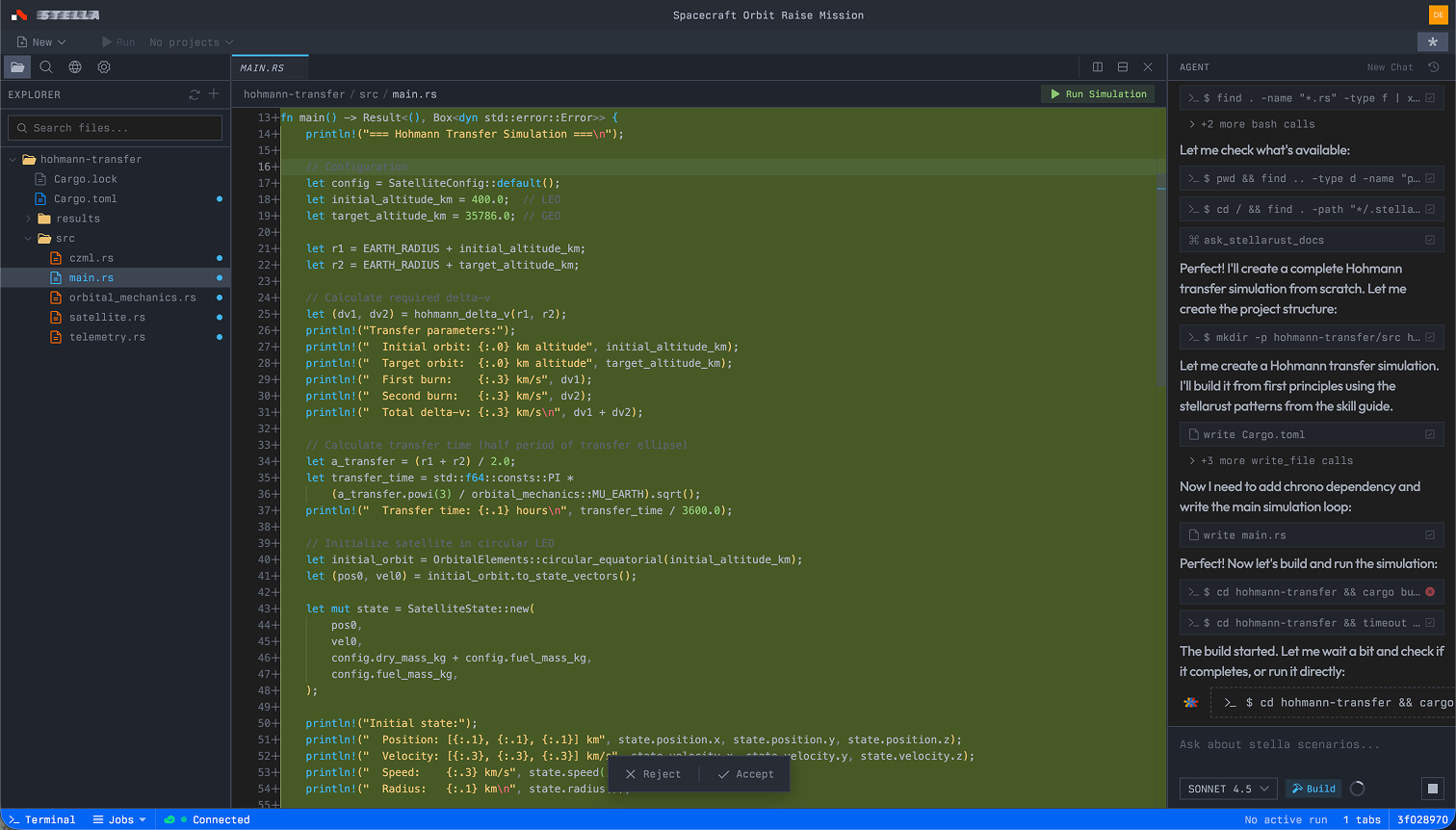
Stella, our GNC and mission simulation platform, compresses that dramatically. Engineers start with a few prompts or upload a mission requirements document and have a fully configured simulation running in under an hour. Stella auto-generates orbital and trajectory parameters, propagation timelines, maneuver scenarios, and constellation dynamics. Instead of building simulations from scratch, you start with an operational mission environment that evolves as vehicle and system designs change.
Mission feasibility becomes the foundation for everything downstream.
2. Aerodynamic & Flow Physics Validation
Once mission profiles are defined, vehicle performance needs to be validated aerodynamically. Traditionally this is slow and infrastructure-heavy. Geometry cleanup, mesh generation, boundary condition setup, solver validation. It can take days to stand up a single CFD run before you get any performance insight.
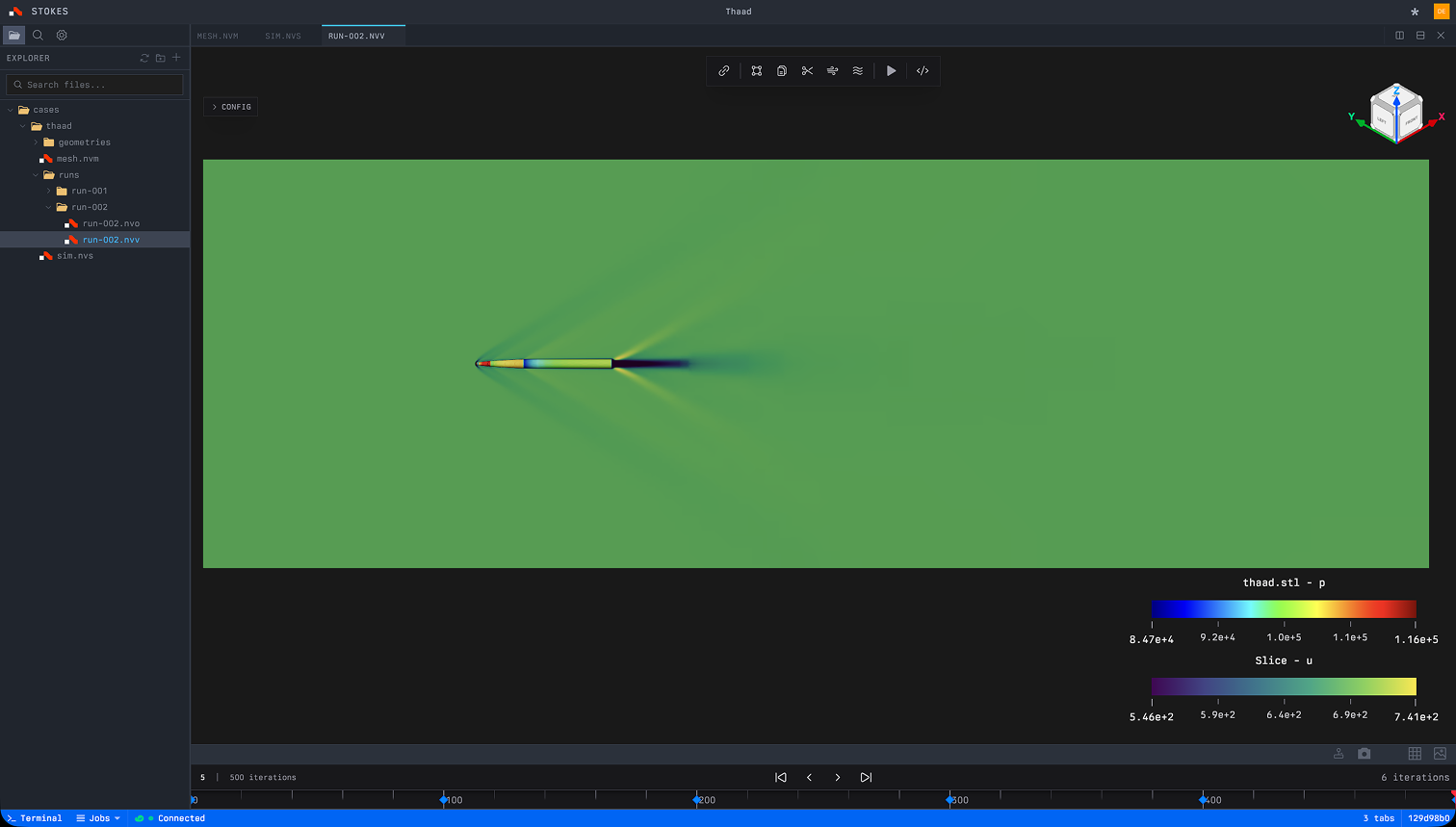
Stokes, our aerodynamicist agent, handles simulation setup autonomously, allowing geometry and operating conditions to move directly into CFD analysis. Instead of spending time configuring solvers, teams focus on interpreting results, when design changes are still cheap to make.
3. Closed-Loop Mission Iteration
This is where the integrated stack starts to pay off. CFD outputs from Stokes don't end up as static reports sitting in someone's folder. They become structured system data.
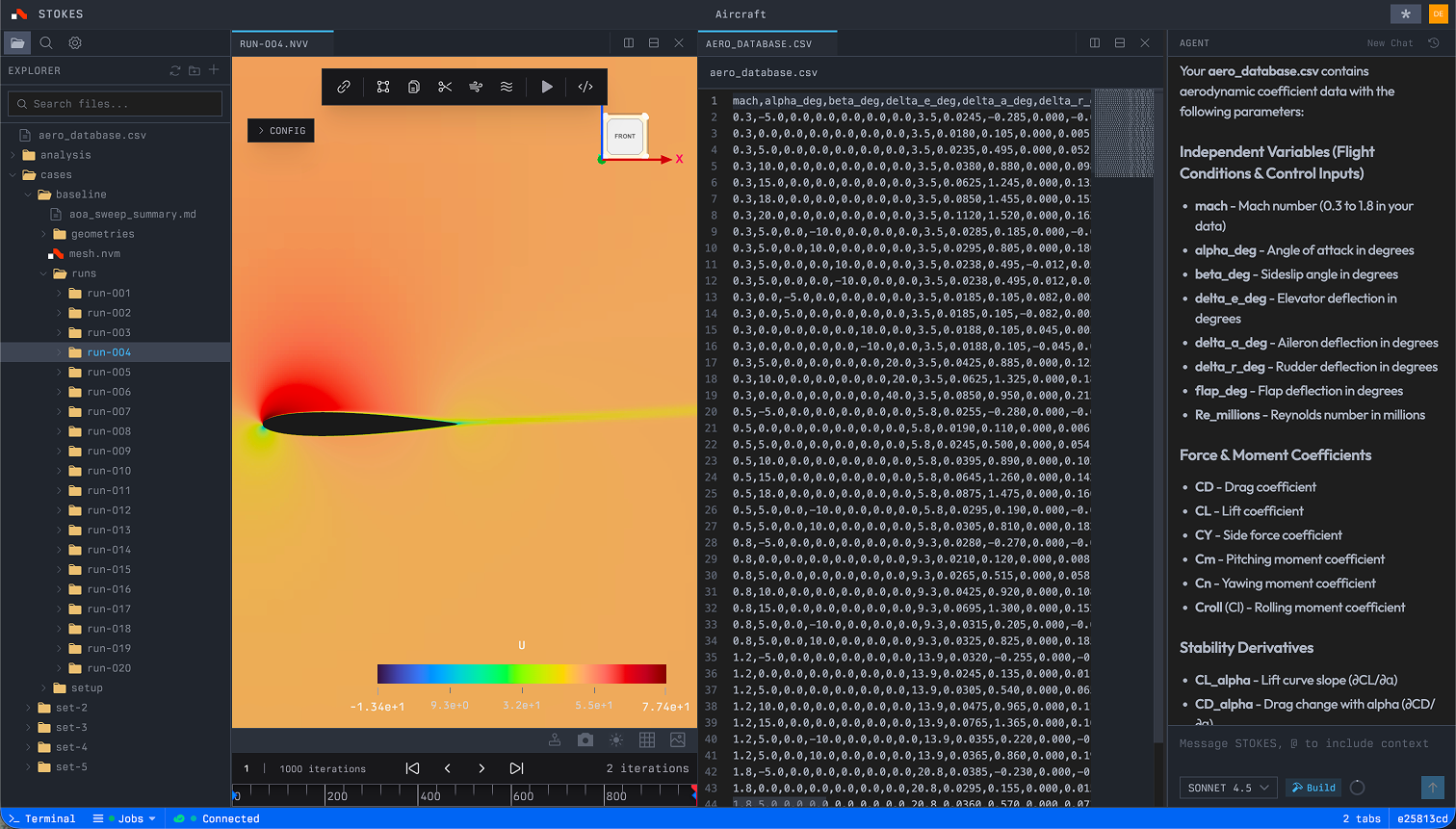
Stokes runs automated parameter sweeps across flight regimes (altitude, velocity, angle of attack, control states) and generates full aerodynamic performance datasets. That data feeds directly back into Stella, where it informs mission and GNC simulation with real vehicle performance numbers.
Mission design and aerodynamic performance evolve together, not sequentially. That's the closed loop.
4. Structural Analysis & Mechanism Sizing
Once aero and mission requirements are validated, structural feasibility is the next constraint.
This is where Ferro, our structural analysis platform and agent, comes in.
Ferro takes aerodynamic loads and mission profiles as inputs and autonomously evaluates structural stresses, material selection, and payload supports. Subsystems get sized against real operating conditions from day one, not in isolation. This directly attacks one of the most expensive failure modes in aerospace: late-stage structural redesigns driven by loads that were poorly understood early on.
5. From GNC Models → Flight Software
Designing a mission and validating vehicle performance is only half the equation. Aerospace systems have to actually execute these missions through flight software.
Inside Stella, GNC models don't stay confined to simulation. Control laws, autonomy behaviors, and maneuver logic developed in Stella's simulated environment compile directly into Rust-based flight software. No model-to-flight translation gap.
What's simulated is what flies.
6. Integrated Product Convergence
At this point, four traditionally siloed disciplines are operating inside one continuous loop: mission engineering, fluid dynamics, structural analysis, and flight software.
Because each layer shares context, everything stays connected. Structural mass informs fuel requirements. Aerodynamic refinements adjust guidance strategies. Mission changes reshape load cases. Engineering becomes multidimensional design exploration instead of a linear handoff chain, and products converge faster because tradeoffs are evaluated continuously.
Why This Matters
When agents own the loop, engineering changes fundamentally.
When you can iterate across disciplines in the same environment, you get faster development timelines, broader design space exploration, earlier risk identification, and lower integration overhead. In an industry where performance margins are thin and timelines are long, iteration speed is a strategic advantage.
This Is Just the Beginning
Today, Navier AI's ecosystem enables closed-loop workflows across mission design and fluid simulation. Structural analysis is entering the stack next.
On March 1st, we're launching the beta of Ferro, bringing structural analysis directly into the agent-driven engineering environment. This is just the start, with additional solvers and disciplines coming soon.
Get Early Access
to Ferro
Structural analysis is entering the agent-driven engineering stack. Be among the first to use it.
Register for Early Access →